📑 “Everyone you meet is fighting a battle you know nothing about. Be kind. Always.” – Robin Williams
Here we are… October is gone — the month the world dedicates to mental health. 🌍
And what a month of learning it has been. Allow me to share some insights with you:
I had the privilege to facilitate a mental health awareness session with a microfinance team here in Rwanda.
From the very start, you could feel it — the curiosity, the tension, the slight awkwardness in the air 😅.
So I asked them, “Why did you come today? What do you expect from this conversation?”
Their answers were honest, raw:
🗣 “Does our employer think we have mental health issues?”
🗣 “I want to know my status.”
🗣 “How can I tell if someone has a mental health problem?”
To respond to the 1st question, I invited four staff to stand up and introduce themselves.
After a short pause, I told the room:
“One of you might have had suicidal thoughts.”
And just like that — silence.
A deep, uncomfortable silence…..
You could almost feel the weight of that statement hanging in the air.
It wasn’t meant to shock, but to awaken something.
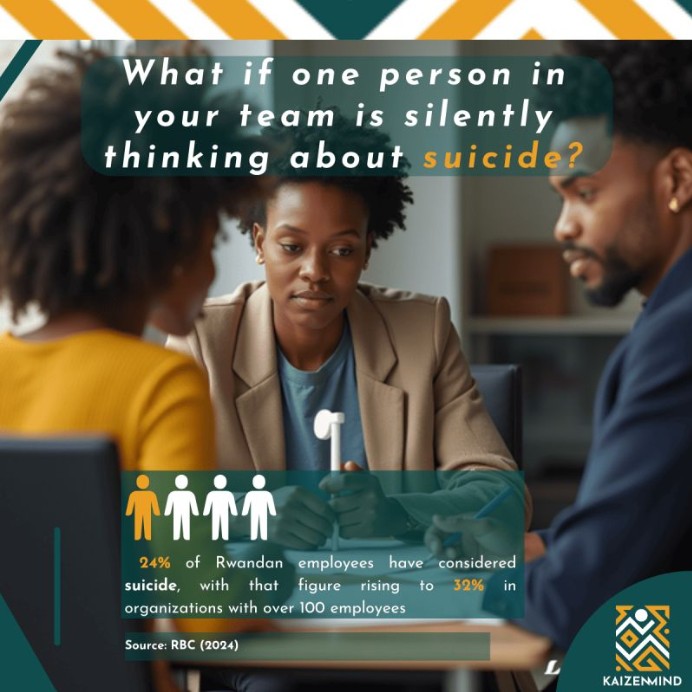
Because this is what the data says, not me reading minds (though people love to think psychologists can do that! 😄).
📌 1 in 4 employees in Rwanda have faced suicidal thoughts (RBC, 2024).
📌 1 in 5 Rwandans live with a mental health condition (RBC, 2018). To put that in perspective, it’s about twice the global average — which is 1 in 8.
So yes, the silence was justified. Because behind that silence are real people, real pain, and real stories we often hide behind smiles.
To respond to the other questions — “How can I know if someone has a mental health problem?” and “How can I help my loved ones?” — I shared something that I believe everyone should understand.
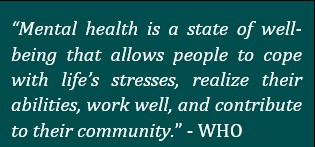
Here is World Health Organization’s definition,
Then, I introduced them to what we call the mental health continuum.
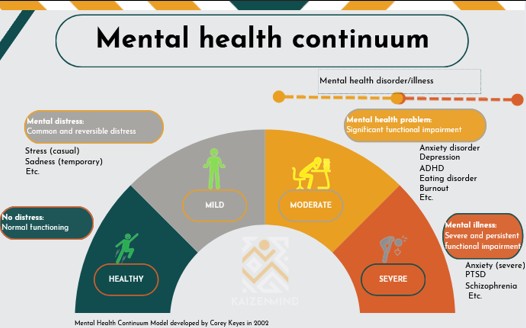
All of us, without exception, live somewhere on this line. Some days we’re in the “healthy” zone — focused, calm, joyful. Other days, life shakes us — stress, grief, pressure — and we slide toward distress. 😔
But here’s the key: we can always move back and forth along that continuum. With awareness, support, and care, we can return to balance
To help them see the full picture, I explained the Biopsychosocial model — which simply means our mental health is shaped by three things:
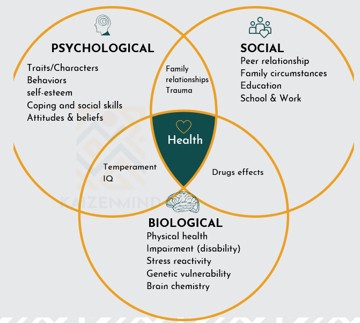
🧬 Biological (like genetics or hormones),
🧩 Psychological (like mindset, trauma, or coping skills),
🤝 Social (like work environment, relationships, finances).
These three constantly interact — which is why a “bad boss,” lack of sleep, or financial stress can impact our mental health just as much as biology can.
And an important note: only trained professionals — doctors, psychologists, psychiatric — can diagnose mental health disorders. Please, let’s stop diagnose others…
During the last hour, we had a Q&A with a counselor from mHub – The Mental Health Hub, and that space turned into something powerful, you could sense relief, even tears behind some smiles.
People began to understand that psychology is not “ibisosi” (theory) it’s a science — one with real tools, proven methods, and measurable impact.
One of the key moments was when the counselor said:
“There’s no illness called Umusazi (crazy).”
That word has done so much harm in our culture.
She explained that what we call “umusazi” is often schizophrenia, a real medical condition that can be treated — just like diabetes or malaria.
No one would call someone “malaria,” right? So why label someone by their illness?
I truly commend that microfinance institution 🙌 for taking the uncomfortable but brave step of talking about mental health at work.
And towards the end of the month, I had another session with entrepreneurs this time.
People often think entrepreneurs are unstoppable. But studies from UC Berkeley and UC San Francisco revealed they are twice as likely to face mental health challenges or suicidal thoughts than the general population.
Pressure. Uncertainty. Loneliness. Financial constraints, “fake it until you make it”, etc. It adds up.
Ah la la… I could write for hours about this topic. There’s still so much to unpack. But one truth remains — we’re making progress. Slowly, yes, but surely. And that deserves to be celebrated. 🎉
If there’s one thing I want you to take away, it’s this:
🌱 Self-awareness is your compass: Pay attention to your shifts — in energy, mood, or sleep.
🌱Care for your mental fitness daily — walk, have your “me-time”, pray, meditate, talk, journal, rest, seek therapy, etc.
🌱Mental health disorders are treatable, and people under care can perform just as well as anyone else — sometimes even better, because they’ve learned resilience through healing
….I know I know….it’s more than one take away!!🙈
Concluding, let’s learn about mental health and keep creating spaces — at work, at home, in community — where people feel safe to speak, heal, and grow.
Because mental health is not a “them or bazungu” issue. It’s an “us” reality. 💚
🌱
…………………………………………………………………………………………………………………………………………..
By
Joie-Claire Museke
Organizational Psychologist
Founder & Managing Director @ KaizenMind
Leave a Reply